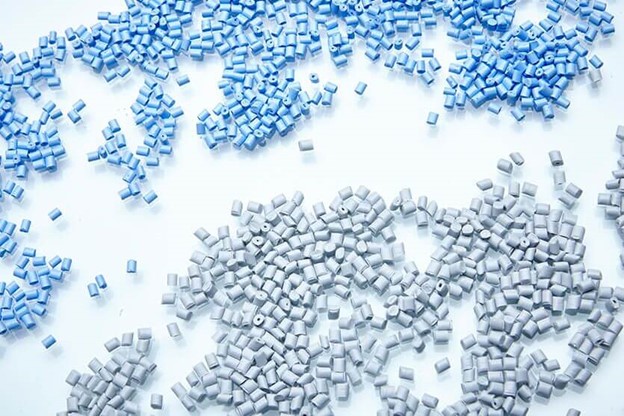
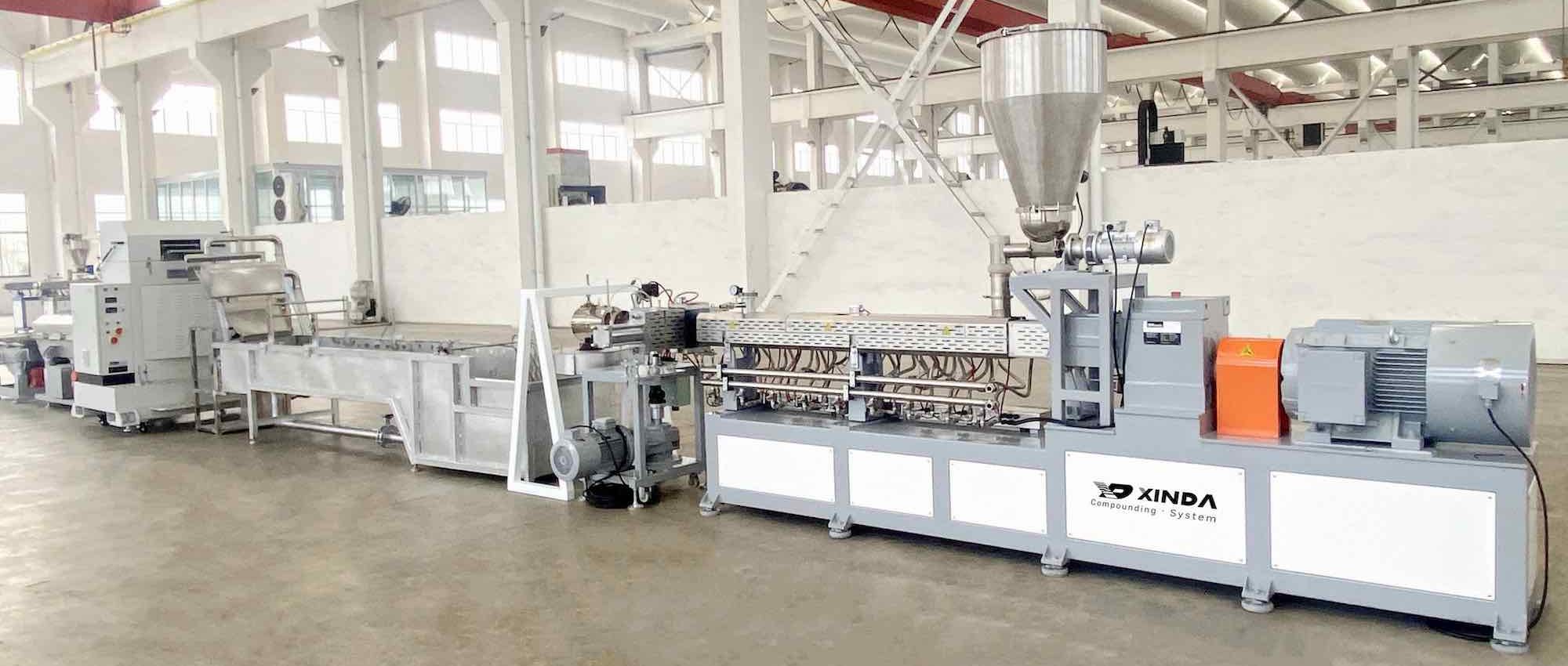
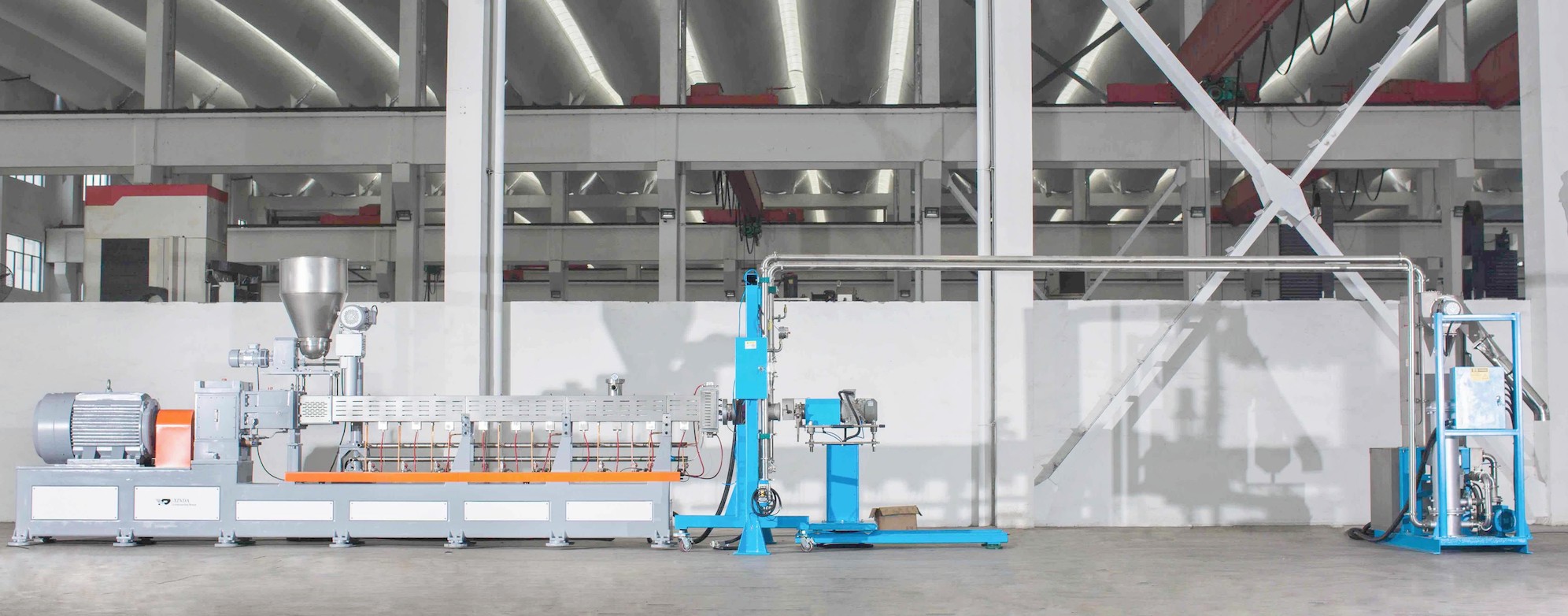
Xinda has ample experience in PET compounding industry and other engineering compounds since 1988. After co-operations with many engineering plastics companies, Xinda extruders is able to achieve high quality result of PA, PC, PET, PBT and POM compounds.
Engineering plastics can be used as engineering materials and plastics that replace metal to manufacture machine parts. Engineering plastics have excellent comprehensive properties, high rigidity, low creep, high mechanical strength, good heat resistance, and good electrical insulation. They can be used for a long time in harsh chemical and physical environments, and can be used as engineering structural materials instead of metals.
Typical areas of application for processing of engineering plastics
• High-filled and reinforced compounds • Polymer foam – EPS • Alloying, coloring • Production of nanocomposites by mixing layer silicates into PP or PA • Gentle mixing of micro hollow glass spheres into PP, PA etc. • Production of long glass fiber compounds by the direct method • Mixing of wood fibers into thermosplastics • Removing moisture from bulk materials with max. 40 % humidity • Devolatilization of polymer solutions with a solvent content of up to 80% • Recycling of PET bottles or PA carpet fiber waste • Processing of high temperature polymers such as PEEK
• Filtration of PC melt for optical applications
Engineering resins are plastic materials that have better mechanical and/or thermal properties than commodity plastics (PS, PVC, PE, PP, etc.). Some types of engineering plastics have replaced metal and wood in many applications (e.g. electrical and electronic, automobile, construction, machinery, and aerospace, etc.). Engineering plastics can be modified with various reinforced agents and additives to achieve high rigidity, low creep, remarkable mechanical strength, excellent heat resistance, and superior electrical insulation. Processing engineering plastics is very challenging. Some materials require a high degree of dispersion and distribution of fillers at high loading rates. Some materials are very sensitive to overheating and hydrolytic degradation. Thus, selecting the right machine and optimizing equipment configuration becomes the top priority.
Processing steps
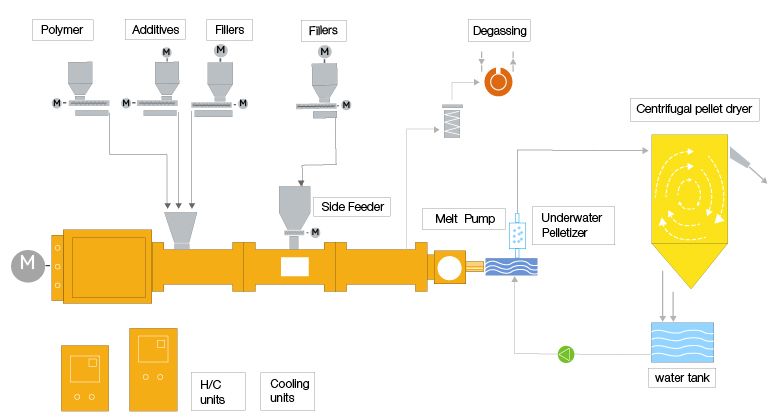
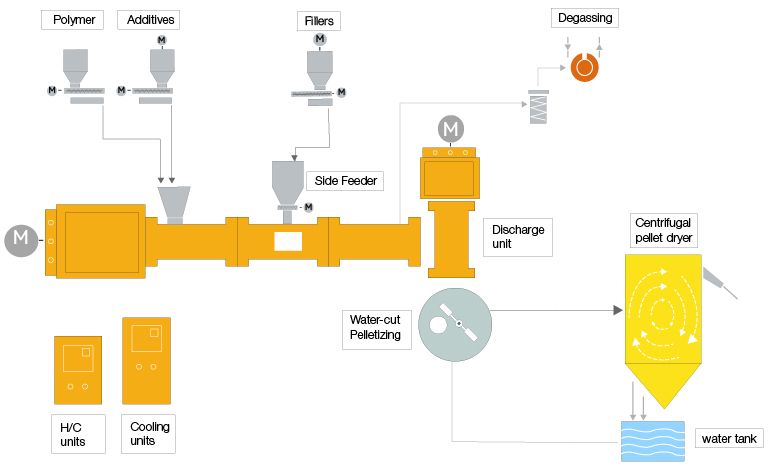
Material handling system-Compounding and extrusion- Water strand pelletizing system/Water ring cutting system/Underwater pelletizing system – Classify – Packing system.
Precise temperature control minimizes polymer degradation:
Temperature prob can immerse into melts through hollow pin in each processing zone so that we can get the accurate real-time temperature all the time.
Gentle shearing minimize damage to high structure carbon black:
Co-kneader’s unique combination of screws, pins and barrels can provide low shear which will reduce the breakage to materials’ physical character.
Uniform distribution of various additives:
Co-kneader’s multiple flights interacted with the pins provides excellent kneading effect by increasing the mixing circles. Thus, various additives can be distributed evenly in the melts.
High filling rate of fillers:
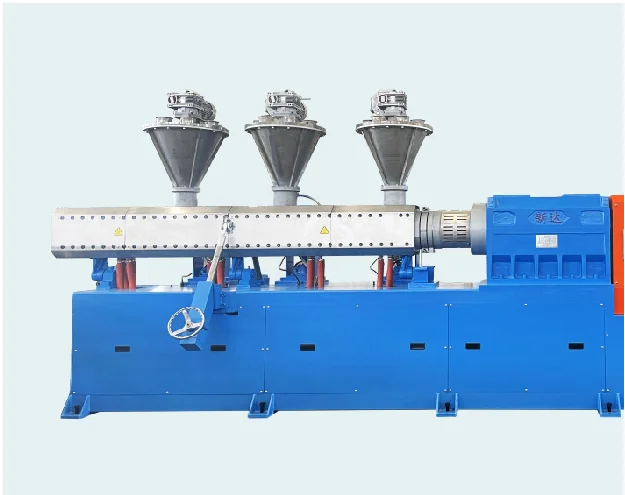
Opening of two or three inlets & low shearing allow the maximum loading rate of inorganic powders.
Flexible screw configuration:
Co-kneader’s screw profile can be changed by adjusting the serial of modular designed screw. Thus, various formulations can be processed on the same machine.